
Domestic violence & healing
Boundaries Are Not
Unforgiveness.
October 2026
There is a lie many hurting people have been taught: if you forgive someone, you must give them full access to you again.
That is not what God asks of us.
Forgiveness releases revenge into God’s hands. Boundaries protect the peace, safety, and healing God is rebuilding in yours. You can pray for someone and still refuse to be mistreated. You can wish them well and still say, “No.” You can love from a distance when closeness is unsafe.
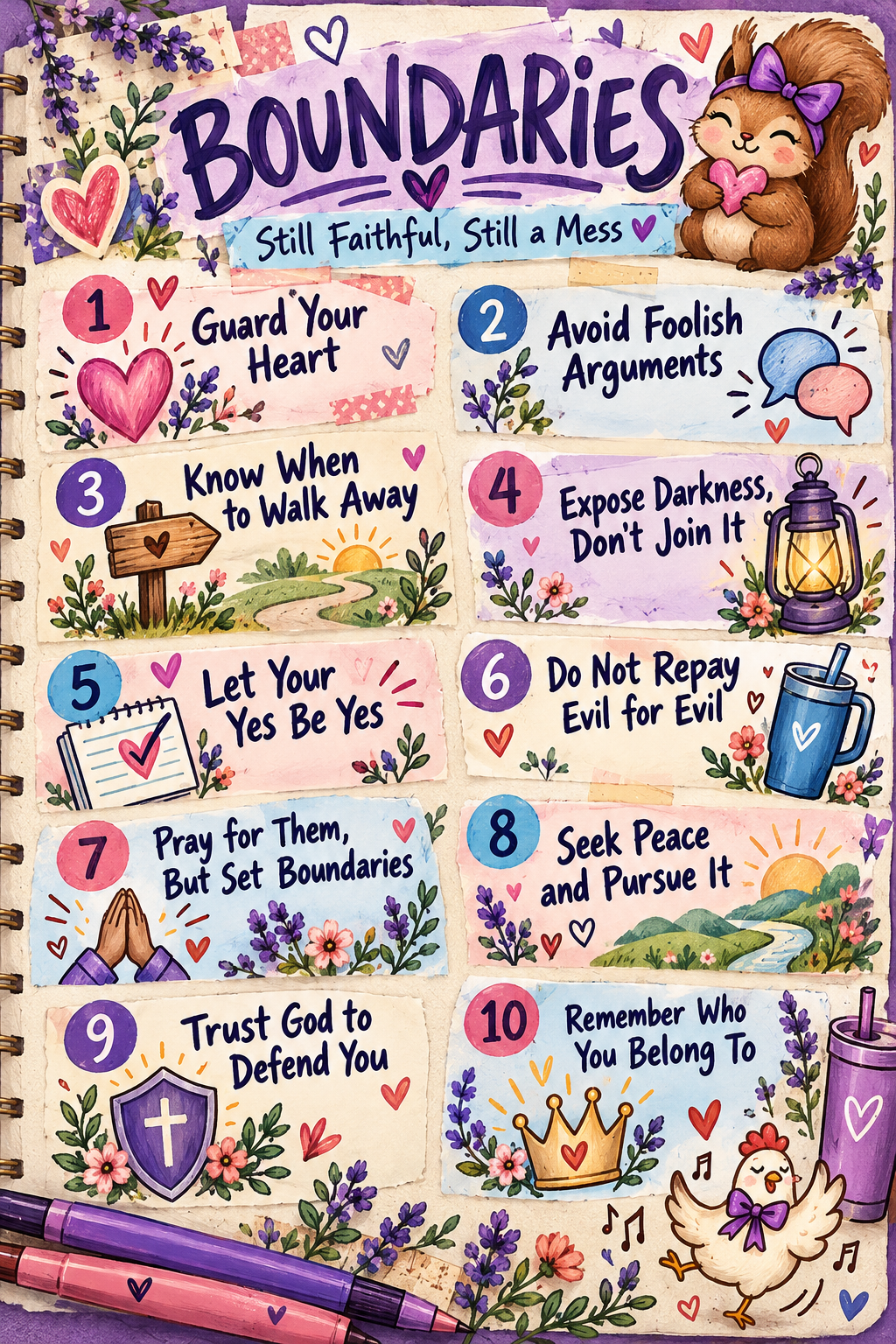
1. Guard your heart
“Guard your heart above all else, for it determines the course of your life.” — Proverbs 4:23
God does not tell us to leave our hearts wide open for every person to wound again. Guarding your heart may mean limiting what you share, stepping back from harmful conversations, blocking someone, or choosing who has access to your time and emotions.
2. Avoid foolish arguments
2 Timothy 2:23 warns us not to get caught in foolish arguments because they produce quarrels.
Not every accusation deserves an answer. Not every lie deserves a long explanation. Some people argue to understand; others argue to control, confuse, or keep you emotionally trapped. You are allowed to stop participating.
3. Know when to walk away
2 Timothy 3:1–5 describes destructive behavior and tells us to keep away from people who persist in it.
Walking away is not always dramatic. Sometimes it is quietly ending the call, leaving the conversation, refusing to keep explaining yourself, or no longer returning to the same harmful cycle.
4. Expose darkness, but do not join it
“Have nothing to do with the fruitless deeds of darkness, but rather expose them.” — Ephesians 5:11
Exposing darkness does not mean becoming cruel, vengeful, or obsessed with proving your point. It can mean telling the truth, documenting what happened, asking for help, reporting abuse, and refusing to pretend harmful behavior is okay. You do not have to become like the person who hurt you to be honest about what they did.
5. Let your yes be yes and your no be no
“Let your ‘Yes’ be ‘Yes,’ and your ‘No,’ ‘No.’” — Matthew 5:37
A boundary is not a long speech someone has to agree with before it counts. “No, that does not work for me.” “I will only discuss our child through text.” “I am not available for that conversation.” “I am leaving now.” Those are complete sentences.
6. Do not repay evil for evil
Romans 12:17 tells us not to repay anyone evil for evil.
This does not mean you must accept evil. It means you do not have to answer cruelty with cruelty. You can be firm without being hateful. You can tell the truth without attacking. You can let consequences happen without taking revenge into your own hands.
7. Pray for them, but set boundaries
Jesus tells us to pray for those who mistreat us. — Luke 6:28
Prayer is powerful, but prayer is not permission for someone to keep hurting you. You can pray that God changes their heart while still protecting yours. You can ask God to heal them without putting yourself—or your child—back into an unsafe situation.
8. Seek peace and pursue it
Psalm 34:14 calls us to turn from evil, do good, and pursue peace.
Peace is not pretending nothing happened. It is not keeping everyone comfortable while you are falling apart inside. Romans 12:18 says to live at peace “if it is possible, as far as it depends on you.” Sometimes peace requires distance because the other person refuses to live peacefully.
9. Trust God to defend you
“The Lord will fight for you; you need only to be still.” — Exodus 14:14
Being still does not mean doing nothing. You may need to document, speak up, get legal help, make a safety plan, or ask trusted people to stand beside you. But you do not have to destroy yourself trying to make everyone see the truth. God sees. God knows. God is not confused by what happened.
10. Remember who you belong to
1 Peter 2:9 reminds us that we are God’s chosen people and His special possession.
You do not belong to the person who mistreated you. You do not belong to their anger, their manipulation, their opinion, or the story they try to tell about you. You belong to God.
A word for survivors who must co-parent
Some survivors cannot fully walk away because a court requires contact with the former abuser who hurt them and their child. That can feel deeply unfair—and it can become another way an abusive person tries to keep control.
Boundaries can still exist there. Keep communication brief, written, and focused only on the child. Respond only to what truly needs a response. Keep records. Do not use your child as a messenger. Follow court orders, but do not give extra access simply because someone demands it. If you need support, a domestic-violence advocate may be able to help with safety planning and local resources, even when an attorney is not affordable.
You are not failing at forgiveness because you need boundaries. You are not bitter because you need safety. You are not unkind because you are done being mistreated.
God can hold both things at once: a heart that chooses forgiveness and a life protected by wise, healthy boundaries.
— Still Faithful, Still a Mess